
Why Contractors and Jurisdictions Are Moving Toward HDPE Grease Interceptors
How corrosion resistance, lower weight, and efficient grease separation are making HDPE the new standard
Grease interceptors play an essential role in protecting commercial plumbing and municipal sewer systems. By capturing fats, oils, and grease—commonly known as FOG—before they enter the wastewater system, these devices help prevent clogged pipes, sewer backups, environmental problems, and costly code violations.
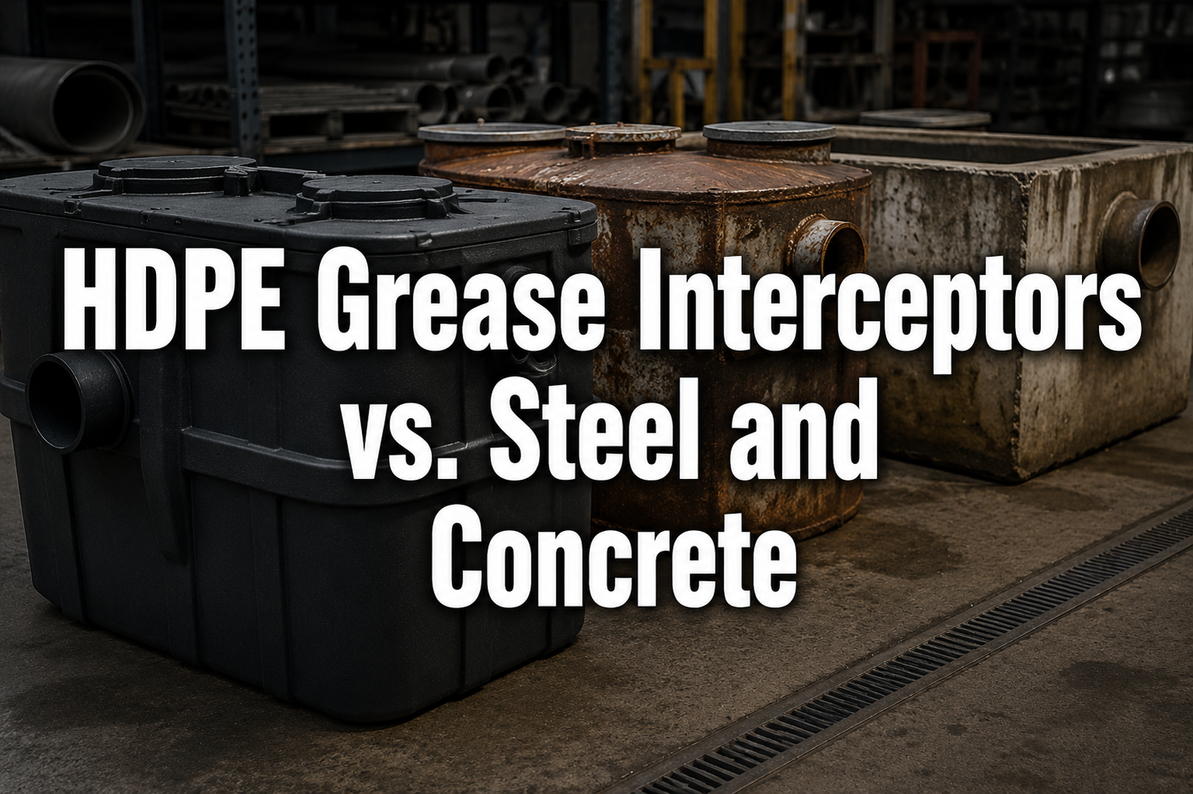
For many years, steel and concrete were the standard materials used for grease interceptors. Today, however, a growing number of plumbing contractors, engineers, facility managers, and local jurisdictions are considering high-density polyethylene (HDPE) interceptors.
Why is the industry changing? The answer comes down to durability, installation, maintenance, and long-term reliability.
The Problem With Traditional Steel and Concrete Interceptors
A grease interceptor operates in a demanding environment. Food waste, grease, cleaning chemicals, moisture, and naturally acidic wastewater can all contribute to the deterioration of traditional materials.
Steel Grease Interceptors
Steel interceptors can provide dependable service, but they may eventually corrode when continuously exposed to grease-laden wastewater. The actual service life depends on several factors, including the quality of the steel, protective coatings, installation conditions, cleaning frequency, and the substances entering the interceptor.
As corrosion progresses, a steel interceptor may develop:
- Rust and material deterioration
- Leaks around the tank or connections
- Failed seals and gaskets
- Odor problems
- Reduced structural integrity
- The need for repair or replacement
Indoor steel interceptors can also be heavy and difficult to position. Sharp edges and tight installation spaces may create additional handling challenges for contractors.
Concrete Grease Interceptors
Concrete interceptors are commonly used for large outdoor and underground installations. Their size and weight, however, can make delivery and installation complicated.
A large concrete interceptor may require a boom truck, crane, or other heavy equipment. The excavation must be ready when the tank arrives, and delays can lead to added equipment, labor, and scheduling costs.
Concrete can also be affected by prolonged exposure to corrosive wastewater conditions. Over time, deterioration or cracking may increase the possibility of leakage and groundwater infiltration.
Why HDPE Is Becoming a Preferred Material
High-density polyethylene is a durable thermoplastic material with excellent resistance to corrosion. Unlike steel, HDPE does not rust. It is also less susceptible than concrete to deterioration caused by acidic or grease-laden wastewater.
The advantages of HDPE grease interceptors may include:
- Strong resistance to rust and corrosion
- Lower weight than comparable concrete tanks
- Easier transportation and jobsite handling
- Reduced need for heavy lifting equipment
- Watertight construction
- Suitability for indoor or underground applications
- Lower long-term risk of material deterioration
The weight difference can be especially important on a jobsite. A large concrete tank may weigh many thousands of pounds, while a similarly sized polyethylene interceptor can weigh substantially less. Depending on the size of the unit, contractors may be able to move it with standard jobsite equipment instead of coordinating a crane or specialized boom truck.
A lighter tank does not mean that installation requirements can be ignored. Excavation, anchoring, backfill, traffic loading, groundwater conditions, and local code requirements must still be evaluated carefully. Contractors should always follow the manufacturer’s installation instructions.
Why Jurisdictions Are Approving More HDPE Interceptors
Local grease authorities are responsible for protecting public sewer infrastructure from excessive FOG discharge. An interceptor that corrodes, cracks, or leaks may allow grease-laden wastewater to enter the soil or pass into the sewer system.
Because HDPE is corrosion-resistant and can be manufactured as a watertight tank, many jurisdictions recognize it as a practical alternative to traditional steel and concrete construction.
Approval is not based on tank material alone. Authorities may also evaluate:
- Required flow rate
- Grease storage capacity
- Applicable plumbing standards
- Testing and certifications
- Access for inspection and cleaning
- Installation location
- Venting and flow-control requirements
- Local pumping and maintenance rules
Requirements vary considerably by location. Before selecting an interceptor, the engineer, contractor, or facility owner should confirm that the proposed model and installation method are acceptable to the authority having jurisdiction.
Gravity and Hydromechanical Grease Interceptors
Material is only one part of interceptor selection. It is also important to understand the difference between gravity grease interceptors and hydromechanical grease interceptors.
Gravity Grease Interceptors
Gravity grease interceptors rely primarily on tank volume and retention time. Wastewater slows as it enters the tank, allowing lighter fats, oils, and grease to rise while heavier solids settle.
These units are frequently installed underground and are often used for larger food-service applications. Many jurisdictions apply the “25% rule,” meaning the interceptor should be cleaned when the combined grease and settled solids occupy approximately 25% of its effective liquid depth.
If grease and solids are allowed to accumulate beyond the permitted level, the interceptor becomes less effective and may begin allowing FOG to pass downstream.
Hydromechanical Grease Interceptors
Hydromechanical grease interceptors are engineered and tested to separate grease at a specific flow rate. They typically use an inlet flow-control device or other internal components to manage the wastewater entering the unit and improve separation.
A properly sized hydromechanical interceptor can often provide effective grease separation in a smaller footprint than a conventional gravity interceptor. This makes hydromechanical units especially valuable when installation space is limited.
Potential advantages include:
- A smaller installation footprint
- Tested performance at a rated flow
- Higher grease-storage capacity in relation to tank size
- More installation options
- Easier access for inspection and maintenance
Capacity and cleaning requirements vary by model. No interceptor should be assumed to operate effectively until completely full. Always follow the manufacturer’s published grease-capacity ratings and the maintenance requirements established by the local jurisdiction.
Why Contractors Are Choosing HDPE
For contractors, the appeal of HDPE extends beyond corrosion resistance. A lighter interceptor can simplify nearly every stage of a project, from delivery through final installation.
HDPE interceptors may help reduce:
- Heavy-equipment requirements
- Jobsite coordination
- Installation labor
- Handling difficulties
- Scheduling delays
- Replacement concerns caused by corrosion
Riser installation can also be easier with systems that permit field adjustment. Finished grade is not always known when an interceptor is ordered, and proprietary risers can be expensive or have long lead times. Select interceptor systems accommodate readily available piping or field-cuttable riser components, allowing the contractor to make final height adjustments at the jobsite.
Riser compatibility varies, so the approved components and installation method should be verified before ordering.
Selecting the Right Grease Interceptor
There is no single interceptor that is right for every commercial kitchen. Proper selection requires more than choosing a tank based on its physical dimensions.
Important considerations include:
- Required gallons-per-minute flow rate
- Grease storage capacity
- Fixture types and quantities
- Available installation space
- Indoor or outdoor placement
- Above-ground or below-ground installation
- Inlet and outlet elevations
- Burial depth and finished grade
- Traffic-loading requirements
- Pumping and cleaning access
- Local plumbing and grease-management regulations
Choosing the wrong size or type of interceptor can result in poor performance, excessive maintenance, difficult installation, or rejection by the local authority.
Get Help Choosing an HDPE Grease Interceptor
Drain-Net supplies grease traps and interceptors for commercial kitchens, food-service facilities, and other demanding applications. Our team can help you compare HDPE, steel, and other available options based on your flow requirements, installation environment, available space, and local regulations.
Whether you need a compact hydromechanical grease interceptor or a large underground system, contact Drain-Net for help identifying the right solution for your project.
Shop Grease Traps and Grease Interceptors now
Recent Posts
-

How to prevent wipes from damaging grinder and macerating pumps
“Flushable” wipes can create serious problems for grinder and macerating pumps. Unlike toilet paper, …18th Sep 2026 -
Why Contractors and Jurisdictions Are Moving Toward HDPE Grease Interceptors
How corrosion resistance, lower weight, and efficient grease separation are making HDPE the new stan …3rd Sep 2026 -

Why Non-Para Urinal Blocks Are the Smarter Choice for Commercial Restrooms
Urinal odor and drain buildup are common problems in restaurants and commercial facilities. What sta …30th Apr 2026